The way people work has changed significantly in recent years. While traditional office-based roles remain important across many industries, remote and flexible work options have also become a major part of the modern job market. For students and job seekers, this creates an important decision: should you pursue a career that is primarily office-based, or one that is more remote-friendly?
Understanding the differences between office careers vs remote friendly careers can help you choose a path that matches your lifestyle, work habits, and long-term goals. Both options offer real advantages. The right fit depends on how you prefer to work, communicate, and manage your daily responsibilities.
In this guide, we compare office careers and remote-friendly careers in Canada, including work environments, job roles, required skills, future trends, and a built-in self-assessment quiz to help you decide which direction may suit you best.
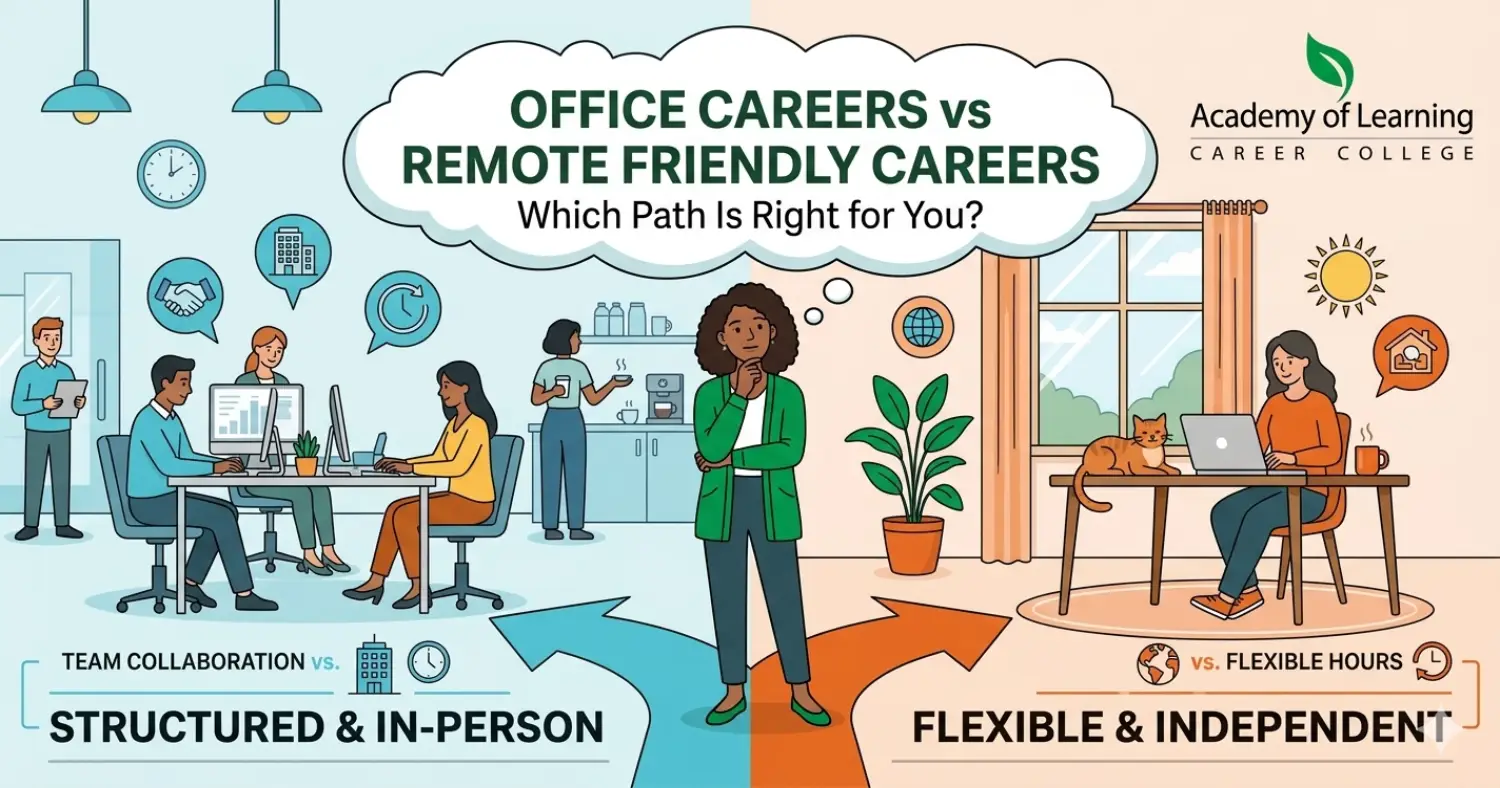
What Are Office Careers?
Office careers are roles that usually require employees to work on-site in a physical workplace such as an office, clinic, legal office, campus, or organization headquarters. These jobs often follow a set schedule and involve regular in-person collaboration.
Common features of office careers include:
- Working on-site during scheduled hours
- Meeting colleagues and supervisors face to face
- Completing tasks in a structured workplace
- Participating in in-person meetings and team discussions
- Following consistent daily routines
Office-based work remains common in areas such as business administration, healthcare support, legal services, accounting, education administration, and customer service.
What Are Remote Friendly Careers?
Remote-friendly careers are roles that can be completed from home or from another location outside a traditional office. These jobs rely on digital systems, online communication, and strong independent work habits.
Common features of remote-friendly careers include:
- Working from home or another remote location
- Communicating through email, chat, phone, and video calls
- Using cloud-based tools and digital platforms
- Completing tasks independently
- Managing work with greater flexibility
Many remote jobs in Canada are found in technology, digital marketing, customer support, bookkeeping, virtual administration, project coordination, and some business services roles.
Why This Career Choice Matters
Work environment affects more than just where you sit during the day. It can influence your stress levels, productivity, work-life balance, communication style, and even long-term career satisfaction.
When comparing office careers vs remote friendly careers, it helps to think about questions like:
- Do you enjoy daily in-person interaction?
- Are you productive with independent work?
- Do you prefer structure or flexibility?
- Are you comfortable using digital tools all day?
- Do you want a clear separation between work and home?
Your answers can guide you toward a path that feels sustainable and rewarding.
Key Differences Between Office Careers and Remote-Friendly Careers
Here is a quick comparison of the two work styles:
| Feature | Office Careers | Remote Friendly Careers |
| Work location | On-site | Home, remote, or hybrid |
| Schedule | More fixed | Often more flexible |
| Communication | In-person | Digital-first |
| Supervision | More direct | More independent |
| Team interaction | Face to face | Online meetings and messages |
| Work-life boundaries | Easier to separate | Can be harder to separate |
| Commute | Usually required | Usually reduced or eliminated |
This is why the comparison between office careers vs remote friendly careers is not just about convenience. It is also about fit.
The Benefits of Office Careers
Office-based roles continue to appeal to many people for very good reasons.
Structured routine
A physical workplace often comes with regular hours, clearer routines, and a stronger sense of daily structure. This can help some people stay organized and focused.
In-person collaboration
Working in the same space as colleagues can make communication faster and easier. It also supports relationship-building and teamwork.
Immediate support
In office environments, it is often easier to ask quick questions, get help from a supervisor, or solve issues in real time.
Strong workplace separation
For many people, leaving home to go to work creates a healthy boundary between professional and personal life.
The Benefits of Remote-Friendly Careers
Remote work offers a different kind of value, especially for those who want flexibility and independence.
More flexibility
Remote roles often give employees more control over their schedules and working style, depending on the company and role.
Less commuting
Remote work reduces travel time and commuting costs. This can improve quality of life and free up hours each week.
Greater location freedom
Some remote jobs allow employees to work from different locations, which can be helpful for people who value mobility or have family responsibilities.
Better fit for independent workers
People who are self-motivated and comfortable managing their own time often thrive in remote-friendly environments.
Challenges of Office Careers
Office careers are not perfect for everyone. Some common drawbacks include:
- Daily commuting
- Less schedule flexibility
- Higher transportation and meal costs
- More rigid workplace routines
These challenges may matter more to people who need flexibility or prefer quiet, independent work.
Challenges of Remote-Friendly Careers
Remote work also comes with its own challenges, such as:
- Less face-to-face interaction
- Greater need for self-discipline
- Potential isolation
- Harder work-life boundaries
- Dependence on technology and stable internet
Success in remote-friendly careers often depends on strong communication, organization, and digital confidence.
Skills Needed for Office Careers
People who succeed in office-based roles often have strengths such as:
- Professional communication
- Team collaboration
- Time management
- Organization
- Adaptability
- Comfort with workplace structure
These skills are especially useful in administrative, healthcare, legal, and business environments.
Skills Needed for Remote-Friendly Careers
People who succeed in remote roles often need:
- Self-motivation
- Time management
- Digital communication skills
- Comfort with online tools
- Independence
- Problem-solving ability
Because many remote jobs in Canada rely heavily on online systems, digital confidence is especially important.
Popular Office-Based Career Paths
Office careers are still strong across many sectors. Common examples include:
- Administrative Assistant
- Medical Office Assistant
- Legal Assistant
- Accounting Clerk
- Receptionist
- Office Coordinator
- Payroll Administrator
These roles often involve regular teamwork, direct supervision, and structured workflows.
Popular Remote-Friendly Career Paths
Remote-friendly careers continue to grow, especially in digital and service-based roles. Common examples include:
- IT Support Specialist
- Web Designer or Developer
- Virtual Administrative Assistant
- Bookkeeper
- Customer Support Representative
- Project Coordinator
- Digital Marketing Assistant
These careers often reward people who are organized, tech-comfortable, and able to work independently.
Hybrid Work: A Middle Ground
For many people, the best answer is not fully office-based or fully remote. Hybrid work combines both.
A hybrid career may include:
- Working from home a few days a week
- Attending in-person meetings or team days
- Balancing structure with flexibility
Hybrid roles are becoming more common in business, accounting, project coordination, and some support roles. This makes the conversation around office careers vs remote friendly careers even more relevant, because many jobs now sit somewhere in between.
Industry Trends in Canada
Canada’s job market includes strong opportunities in both office-based and remote-friendly roles.
Office-based roles remain essential in:
- Healthcare
- Legal services
- On-site administration
- Education support
- Clinical and community services
Remote-friendly roles continue to grow in:
- Information Technology
- Digital services
- Online customer support
- Remote administration
- Accounting and bookkeeping
This means there is no single “better” option overall. The best path depends on the nature of the role and the type of work environment that fits you.
Training That Can Support Both Paths
Career-focused education can prepare students for either office-based or remote-friendly work, depending on the program and profession.
At Academy of Learning Career College, Toronto campus, students can explore programs in:
- Law
- Business
- Accounting
- Healthcare
- IT
These areas can lead to both traditional office careers and, in some cases, remote-friendly roles. For example, healthcare support roles are often more office or site-based, while some IT and accounting roles may offer remote or hybrid options depending on the employer.
Quick Self-Assessment: Which Path Fits You Better?
If you are still unsure, this short quiz can help you think through your preferences.
For each question, choose the answer that sounds most like you. Keep track of whether you answer mostly A or mostly B.
1. How do you prefer to communicate at work?
A. Face to face with people around me
B. Through email, chat, and video calls
2. What type of schedule suits you best?
A. A fixed routine with clear hours
B. A flexible schedule with more independence
3. How do you feel about commuting?
A. I do not mind it and I like leaving home for work
B. I would rather avoid it and work from home
4. What kind of support helps you work best?
A. Having people nearby for quick questions
B. Working independently and checking in online
5. What keeps you most productive?
A. A structured workplace and clear routine
B. Autonomy and control over my work environment
6. How do you feel about teamwork?
A. I prefer working closely with people in person
B. I am comfortable collaborating online
7. Which work style sounds more natural to you?
A. Shared office environment
B. Quiet independent workspace
8. How comfortable are you with digital tools?
A. Comfortable, but I still like regular in-person interaction
B. Very comfortable doing most of my work online
9. What matters more to you?
A. Clear boundaries between work and home
B. Greater flexibility during the day
10. How do you like to learn at work?
A. Through in-person guidance and mentorship
B. Through online resources and self-directed learning
Quiz Results
Mostly A answers
You may be better suited to office careers.
You likely value structure, routine, and in-person interaction. Office-based roles may help you feel more connected, supported, and focused throughout the day. Careers in administration, law, healthcare support, and on-site business operations may fit you well.
Mostly B answers
You may be better suited to remote-friendly careers.
You likely value independence, flexibility, and digital communication. Remote-friendly roles may allow you to work in a way that feels more efficient and comfortable. Careers in IT, remote administration, bookkeeping, and digital services may be a strong fit.
A mix of A and B answers
You may be a good fit for hybrid work.
If your answers were balanced, you might do best in a role that combines flexibility with occasional in-person collaboration. Hybrid careers can offer the best of both worlds for many professionals.
Real-World Example: Office vs Remote Work Style
Consider two entry-level professionals:
Example 1: Office-based administrative role
One person works in a busy medical office. Their day includes greeting clients, handling paperwork, speaking directly with coworkers, and managing schedules on-site. They enjoy the routine and the personal interaction.
Example 2: Remote support role
Another person works as a remote bookkeeping assistant. Their day includes updating records, responding to email, attending video meetings, and managing tasks independently from home. They enjoy the quiet focus and flexibility.
Both professionals are successful. The difference is not which job is better. It is which environment fits the person better.
How to Choose Between Office and Remote-Friendly Careers
When deciding between office careers vs remote friendly careers, ask yourself:
- Do I work better around people or alone?
- Do I want more structure or more flexibility?
- Am I comfortable managing my own time?
- Do I prefer face-to-face support?
- Do I want a career that may offer hybrid options later?
You do not need to choose based only on trends. Choose based on what helps you perform well and feel comfortable.
FAQs About Office Careers vs Remote Friendly Careers
-
What is the difference between office careers vs remote friendly careers?
Office careers usually require on-site work, while remote-friendly careers can often be done from home or another remote location using digital tools.
-
Are remote jobs in Canada still growing?
Yes. Remote jobs continue to grow in fields like IT, bookkeeping, digital services, customer support, and virtual administration.
-
Are office careers still a good choice?
Yes. Many stable careers in healthcare, business, law, and administration still rely heavily on in-person work and structured office environments.
-
Which is better for work-life balance?
Remote-friendly roles may offer more flexibility, but office careers can create clearer boundaries between work and home.
-
Do remote-friendly careers require different skills?
Yes. Remote roles often require stronger self-discipline, digital communication, and independent time management.
-
Can accounting jobs be remote-friendly?
Some accounting and bookkeeping roles can be remote or hybrid, depending on the employer and the nature of the work.
-
Are healthcare careers usually office-based?
Many healthcare support roles are site-based because they involve direct service, patient interaction, or on-location responsibilities.
-
What careers are best for people who like routine?
Office careers may be a better fit for people who prefer clear schedules, workplace structure, and regular in-person support.
-
What careers are best for independent workers?
Remote-friendly careers often suit people who are self-motivated, organized, and comfortable working independently.
-
Is hybrid work common in Canada now?
Yes. Many employers now offer hybrid work arrangements that combine remote work with some in-office time.
-
Can training prepare me for both office and remote-friendly jobs?
Yes. Many programs teach transferable skills such as communication, organization, digital literacy, and professionalism.
-
What areas does Academy of Learning Career College, Toronto campus offer programs in?
The campus offers a range of programs in Law, Business, Accounting, Healthcare, and IT.
-
How can I contact Academy of Learning Career College, Toronto campus?
Phone Number: +1 (416) 969-8845,
Email: info@aoltoronto.com,
Address: 401 Bay St 10th Floor, Toronto, ON M5H 2Y4
Conclusion
The choice between office careers vs remote friendly careers is really a choice about how you work best. Some people thrive in structured, in-person environments with direct collaboration. Others do their best work independently with the flexibility of remote tools and home-based routines.
Both paths offer real opportunities in Canada’s job market. By understanding your preferences, strengths, and goals, you can choose a work style that supports both career growth and day-to-day satisfaction.