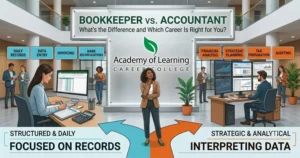
If you are considering a career in finance or business administration, you may come across two strong and practical options: payroll administration and computerized accounting. Both roles are in demand, offer stable career paths, and provide opportunities across many industries.
However, while they are related, they are not the same. Understanding the differences between payroll administrator vs computerized accounting roles can help you choose the path that best fits your strengths, interests, and long-term goals.
In this guide, we break down responsibilities, required skills, career growth opportunities, and real-world applications to help you make an informed decision within accounting careers in Canada.
What Does a Payroll Administrator Do?
A payroll administrator focuses specifically on managing employee compensation. This includes calculating wages, ensuring accurate deductions, and maintaining compliance with payroll regulations.
Key responsibilities include:
- Calculating employee wages and salaries
- Processing payroll on a weekly or bi-weekly basis
- Managing tax deductions and benefits
- Tracking overtime and leave balances
- Preparing payroll reports
- Ensuring compliance with government regulations
Payroll administrators play a critical role in ensuring employees are paid accurately and on time.
What Does a Computerized Accounting Professional Do?
A computerized accounting professional handles a broader range of financial tasks using accounting software.
Key responsibilities include:
- Recording financial transactions
- Managing accounts payable and receivable
- Preparing financial reports
- Maintaining financial records
- Assisting with budgeting and forecasting
- Using accounting software such as QuickBooks or Sage
These roles focus on the overall financial health of a business rather than just payroll.
Key Differences: Payroll Administrator vs Computerized Accounting
Understanding the core differences helps clarify which role suits you best.
| Feature | Payroll Administrator | Computerized Accounting |
| Focus | Employee compensation | Full financial operations |
| Scope | Specialized | Broad |
| Daily tasks | Payroll processing | Reporting, bookkeeping, analysis |
| Software use | Payroll systems | Accounting software |
| Work style | Repetitive, deadline-driven | Varied, analytical |
Both roles are essential, but they differ in scope and day-to-day responsibilities.
Responsibilities Compared
Payroll Administrator Responsibilities
Payroll roles are highly structured and follow consistent cycles.
Typical tasks include:
- Calculating wages and deductions
- Processing payroll transactions
- Issuing pay statements
- Maintaining payroll records
- Ensuring legal compliance
- Responding to employee payroll inquiries
Accuracy is critical, as errors can directly affect employees and compliance requirements.
Computerized Accounting Responsibilities
Accounting roles involve a wider range of financial activities.
Typical tasks include:
- Recording and organizing financial data
- Managing invoices and payments
- Preparing financial statements
- Monitoring expenses and budgets
- Reconciling accounts
- Supporting financial decision-making
These roles often involve more variation and analytical thinking.
Work Environment and Daily Experience
Payroll Administrator
Payroll administrators often work in:
- Corporate offices
- HR departments
- Accounting departments
The work is:
- Deadline-driven
- Routine-based
- Focused on accuracy
Payroll cycles create predictable schedules but require precision.
Computerized Accounting
Computerized accounting professionals work in:
- Businesses of all sizes
- Accounting firms
- Government and non-profit organizations
The work is:
- Varied
- Analytical
- Process-oriented
Tasks may change depending on the financial needs of the organization.
Skills Required for Each Role
Payroll Administrator Skills
- Strong attention to detail
- Knowledge of payroll systems
- Understanding of tax regulations
- Time management
- Confidentiality
- Communication skills
Payroll professionals must handle sensitive employee data responsibly.
Computerized Accounting Skills
- Accounting software proficiency
- Analytical thinking
- Organization and recordkeeping
- Problem-solving ability
- Numerical aptitude
- Reporting and documentation skills
These skills support broader financial operations.
Career Opportunities and Job Roles
Payroll Career Path
Common roles include:
- Payroll clerk
- Payroll administrator
- Payroll supervisor
Payroll roles are often part of HR or finance departments and can lead to specialized positions.
Computerized Accounting Career Path
Common roles include:
- Accounting clerk
- Accounts payable/receivable clerk
- Bookkeeper
- Financial assistant
These roles provide a foundation for more advanced accounting positions.
Career Growth Potential
Payroll Growth
Payroll professionals can advance into:
- Payroll management roles
- HR and compensation roles
- Compliance and auditing positions
Specialization in payroll systems can also increase earning potential.
Computerized Accounting Growth
Accounting professionals have broader career pathways, including:
- Senior accounting roles
- Financial analysis
- Management positions
- Specialized accounting fields
Because of its wider scope, computerized accounting may offer more diverse long-term opportunities.
Industry Demand in Canada
Both roles are in demand across accounting careers in Canada.
Payroll Demand
- Every company needs payroll processing
- Compliance requirements are increasing
- Businesses require accurate employee compensation
Accounting Demand
- Financial management is essential
- Reporting and analysis are ongoing needs
- Businesses rely on accurate financial data
This demand ensures strong job prospects for both career paths.
Education and Training Pathways
Career-focused training programs can help students enter these fields quickly.
At Academy of Learning Career College, Toronto, students can choose between programs aligned with both career paths.
These programs focus on practical skills, software training, and real-world applications.
Which Career Is Right for You?
Choosing between payroll administrator vs computerized accounting depends on your interests and strengths.
Choose Payroll Administrator if you:
- Prefer structured, routine work
- Enjoy working with payroll systems
- Are detail-oriented
- Like working with deadlines
- Want a specialized role
Choose Computerized Accounting if you:
- Prefer varied responsibilities
- Enjoy analyzing financial data
- Want broader career options
- Are interested in business operations
- Like working with multiple financial tasks
Real-World Example Comparison
Scenario 1: Payroll Administrator
You are processing payroll for employees, ensuring all wages, deductions, and taxes are calculated correctly before payday.
Scenario 2: Computerized Accounting Role
You are reviewing financial records, preparing reports, and analyzing expenses to support business decisions.
Both roles are important, but they require different types of focus.
Why Both Careers Are Strong Choices
Both payroll and computerized accounting roles are essential to business operations.
- Payroll ensures employees are paid accurately
- Accounting ensures financial stability and planning
These functions are critical across industries, making both careers stable and valuable.
FAQs About Payroll Administrator vs Computerized Accounting
-
What is the difference between payroll administrator vs computerized accounting?
Payroll focuses on employee compensation, while computerized accounting covers broader financial tasks like reporting and bookkeeping.
-
Which career is better in Canada payroll or accounting?
Both are strong choices. Payroll is specialized, while accounting offers broader career opportunities.
-
Are payroll jobs in demand in Canada?
Yes, payroll roles are in demand because every business must manage employee compensation.
-
Are computerized accounting jobs in demand?
Yes, accounting roles are consistently needed across industries for financial management.
-
Which role requires more attention to detail?
Both require attention to detail, but payroll errors can directly affect employee pay.
-
Which career offers more variety?
Computerized accounting roles typically involve a wider range of tasks.
-
Can I move from payroll to accounting?
Yes, some skills are transferable, but additional training may be required.
-
Do both roles require software skills?
Yes, payroll uses payroll systems, while accounting uses financial software.
-
Is payroll a stressful job?
It can be deadline-driven, especially during payroll cycles.
-
Is accounting a good long-term career?
Yes, accounting offers strong stability and opportunities for advancement.
-
How long is the Payroll Administrator program and Computerized Accounting Program?
Payroll Administrator is a 17-week program, while Computerized Accounting is a 30-week program.
-
How can I contact the Academy of Learning Career College, Toronto?
Call Us: +1 (416) 969-8845
Email Us: info@aoltoronto.com
Visit Us: 401 Bay St 10th Floor, Toronto, ON M5H 2Y4
Conclusion
When comparing payroll administrator vs computerized accounting, both career paths offer stability, demand, and opportunities within accounting careers in Canada. The right choice depends on whether you prefer a specialized, structured role or a broader, more varied financial position.
Both paths provide a strong foundation for building a successful and rewarding career in today’s workforce.